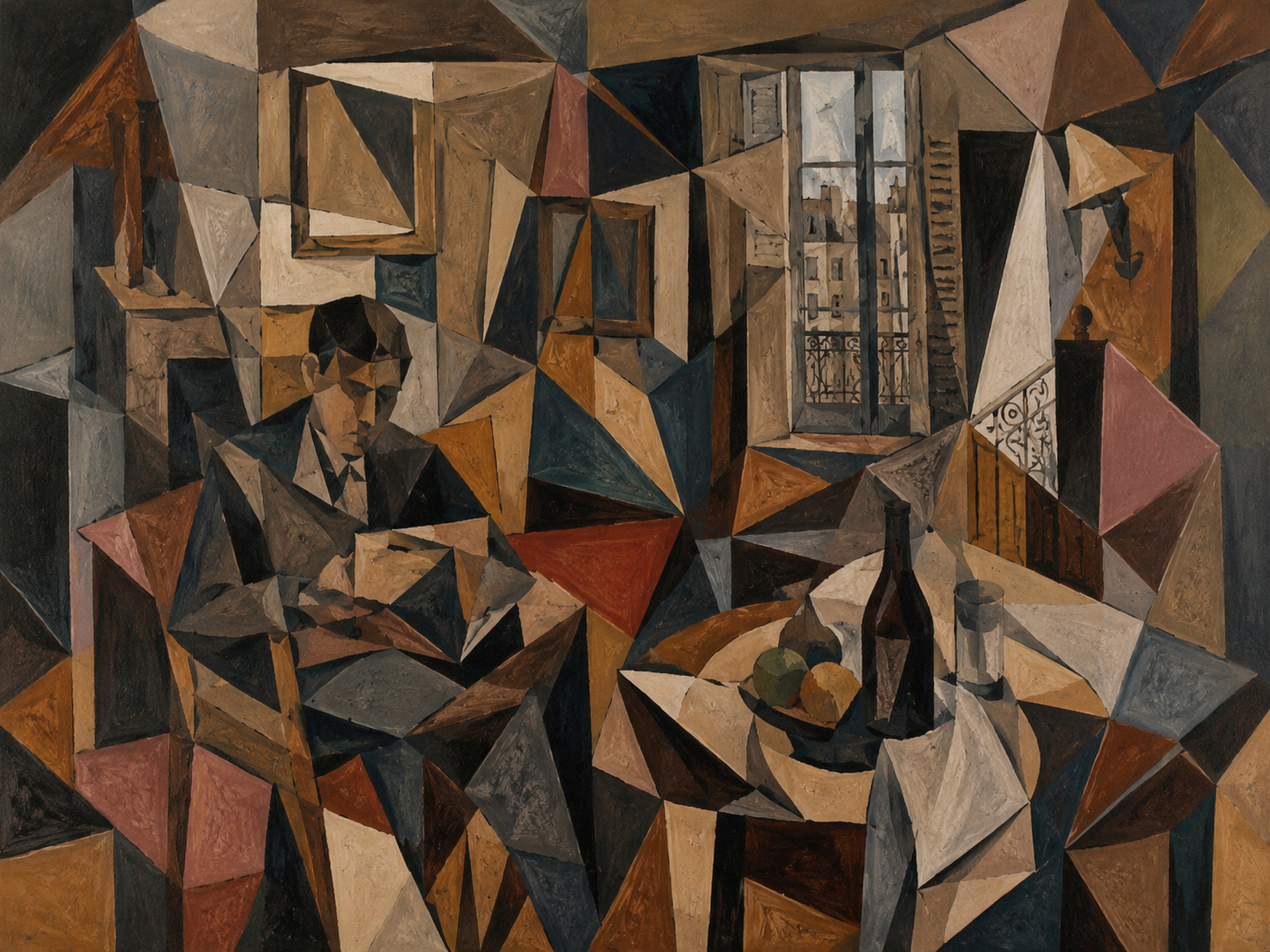
The room broke. The painting got smarter.
Cubism does not simply distort things for fun. It asks a serious question: what if a painting could show more than a single frozen viewpoint? A traditional painting often behaves like a window. Cubism behaves more like walking around the object, remembering it, analyzing it, and rebuilding it as a visual argument.
What Cubism is
Cubism is a modern art movement built around fragmented forms, overlapping planes, compressed space, and multiple viewpoints. Instead of pretending the viewer sees the world from one perfect spot, Cubism folds several moments of seeing into one image.
That is why Cubist paintings often include faces in profile and front view at the same time, tables that tilt toward the viewer, instruments broken into rhythmic shapes, and interiors that feel like architecture, memory, and puzzle box at once.
How to look at Cubism
Do not start by asking, “What is it supposed to be?” Start with the structure. Look for edges, repeated curves, triangles, bottle necks, hands, eyes, letters, instruments, table corners, and shadows. Cubism hides the familiar inside a system of angles.
- Find the object: guitar, bottle, face, newspaper, table, chair, window.
- Find the viewpoints: front, side, above, memory, motion.
- Find the rhythm: repeated angles, curves, verticals, and diagonals.
- Find the joke: Cubism often treats reality like a very serious paper sculpture.
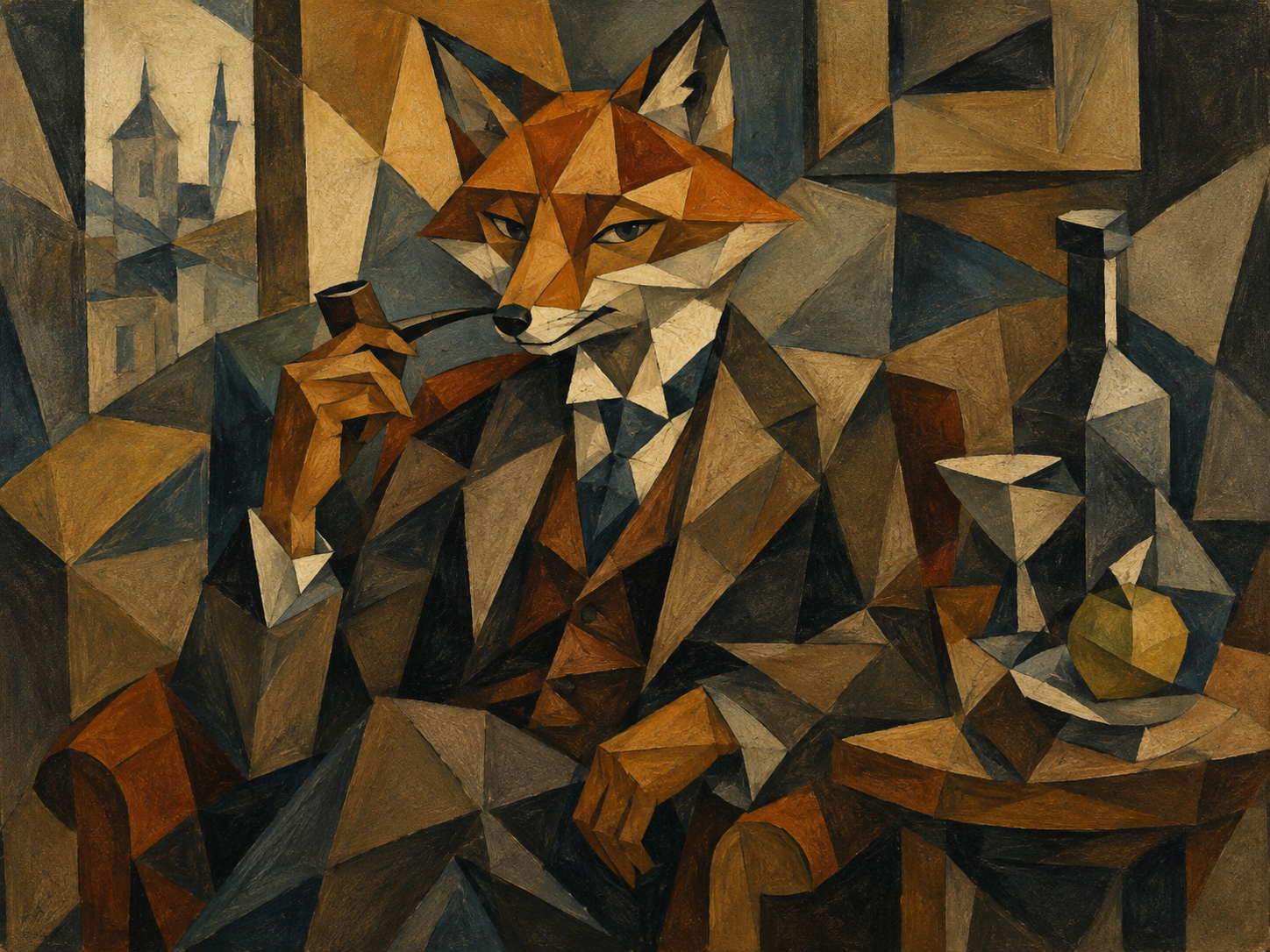
Cubist Fox
The house detective of broken perspective. He sees every side of the case at once, which is useful and deeply annoying.
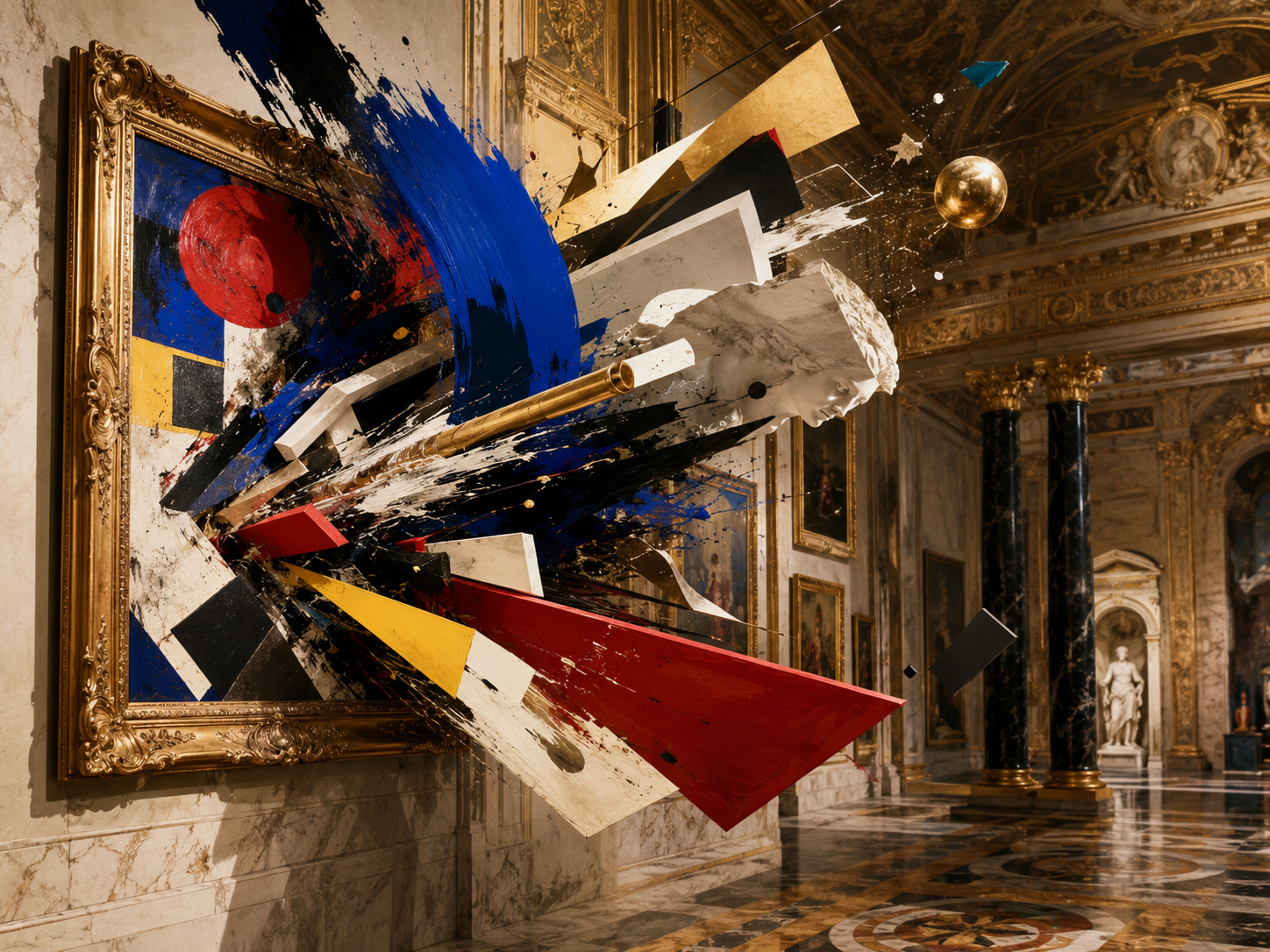
Modern Art Breaks the Frame
Cubism helped art stop acting like a polite window and start behaving like an invention.
Two Cubist moods
Analytic Cubism
This is the smoky, brainy Cubism: muted browns, grays, ochres, and dense webs of broken forms. It feels like looking through a crystal, a diagram, and a memory at the same time.
Synthetic Cubism
This is the bolder, more playful Cubism: collage, pasted paper, clearer shapes, lettering, brighter pattern, and the sense that the painting is built from signs as much as sights.
Why Cubism mattered
Cubism changed the job of painting. After photography, artists did not need to prove they could copy appearances. Cubism showed that painting could analyze perception, rebuild reality, and make the viewer participate in assembling the image.
It opened doors for abstraction, collage, design, modern typography, architecture, and nearly every later movement that decided art did not have to behave.
FineArtDaily museum trick
When a Cubist work feels confusing, pretend you are walking around a sculpture while holding a sketchbook. The painting is not one glance. It is several glances compressed into one surface.
“The answer is not hidden. It is folded.”
Do not demand one perfect view. Follow the angles, find the objects, and let the painting rebuild itself in your head.