
Character Summary
Who is Professor Perspective?
Professor Perspective is the FineArtDaily guide to depth, space, and visual order. When a painted room feels too flat, too tilted, too cramped, or mysteriously theatrical, he appears with a chalk line and a patient sigh.
He does not ruin the mystery of art. He shows how artists build mystery with structure. A table points somewhere. A floor tile repeats. A road narrows. A ceiling opens. A crowd gets arranged so your eye walks through the scene like a tiny museum visitor with excellent shoes.
His job in the museum
Professor Perspective explains why pictures feel deep. He turns the hidden architecture of a painting into something visitors can actually see.
He finds the horizon.
The horizon line is often the secret backbone of a composition. It tells you where eye level lives.
He tracks the vanishing point.
Parallel lines may look like they meet in the distance. Professor Perspective treats that meeting place like a clue.
He checks the scale.
Figures shrink, buildings recede, tables tilt, and space becomes believable when scale is handled with care.
He respects weirdness.
Not every painting wants perfect math. Sometimes the distortion is the point, the joke, or the emotional punch.
The Professor Perspective lesson
Before asking what a painting “means,” ask how it moves your eye. Where does your gaze enter? Where does it stop? What lines pull it forward? What shape holds the scene together?
Perspective is not just math. It is stage direction for your eyes.
His favorite tools
- Horizon line: the viewer’s eye-level anchor.
- Vanishing point: the distant meeting place of receding lines.
- Orthogonals: the diagonal guide lines that create depth.
- Overlapping forms: one object partly covering another to show space.
- Atmospheric perspective: distant objects getting softer, cooler, or hazier.
Where he appears

Episode 5: Professor Perspective Fixes the Room
A crooked gallery refuses to behave until the professor finds the missing vanishing point.
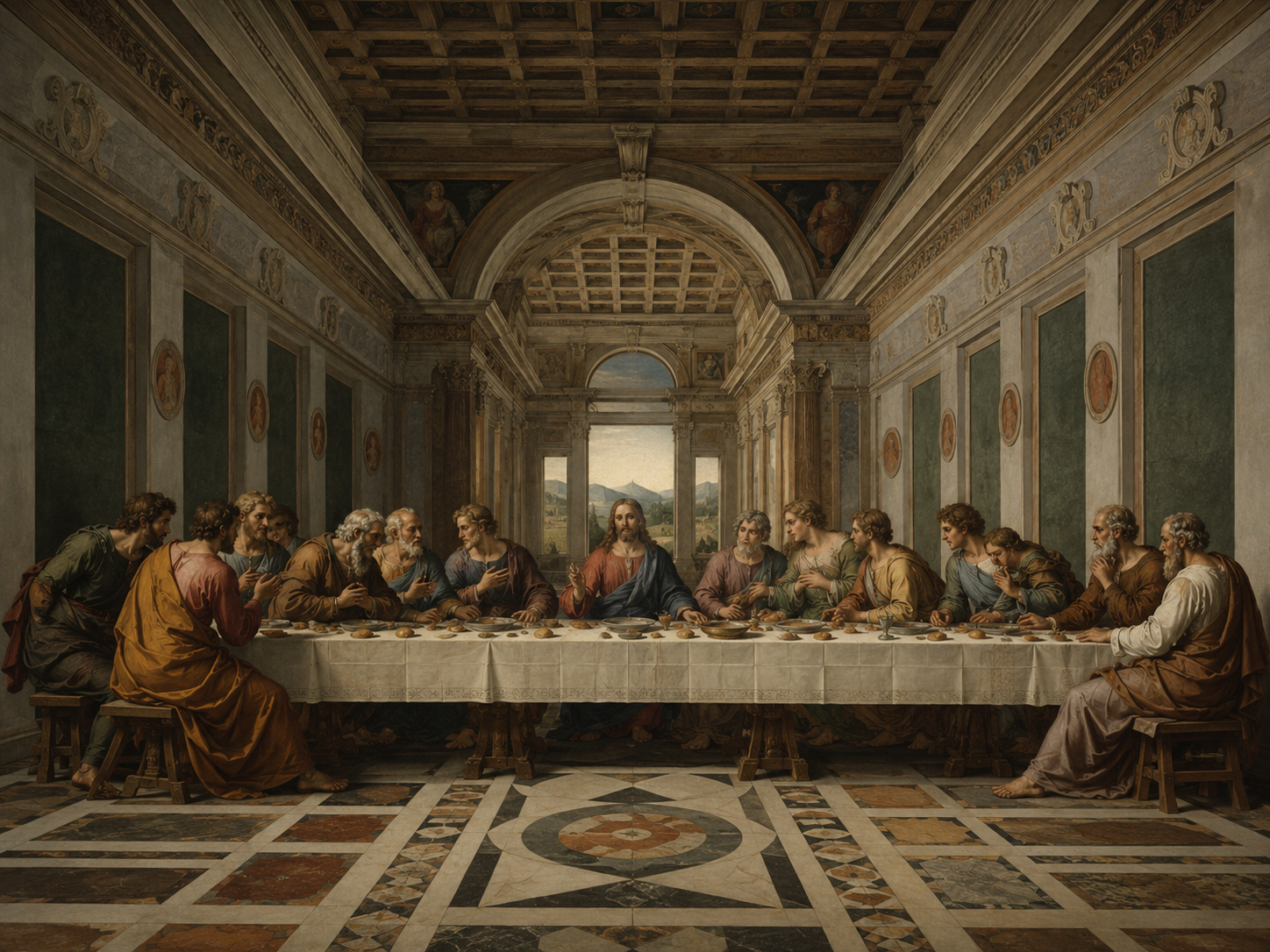
The Last Supper Perspective Room
A classic lesson in how architecture can direct the eye toward the center of drama.
Public-domain note
Professor Perspective teaches through original FineArtDaily illustrations inspired by historical art. When the site discusses specific museum objects or direct reproductions, the page should verify the museum image license before publishing.
Next stop: the movements room
Perspective is one of the great engines of Renaissance art, but later movements bend, break, and reinvent it.